


Menu
AI vs Radiologist
An honest comparison. We build an AI tool, and we'll still tell you plainly that it does not replace a radiologist.
The straight answer
No, AI does not replace a radiologist, and it is worth understanding why, because the reason isn't simply “the AI isn't good enough yet.”
A radiologist doesn't only look at an image. They read it against your history, your symptoms, your previous scans, and what the referring doctor was asking. They decide what matters and what doesn't. And they are professionally accountable for that judgement.
An AI tool reads pixels. It has none of that context unless you hand it over, and no accountability at all. Those are different jobs, not different quality levels of the same job.
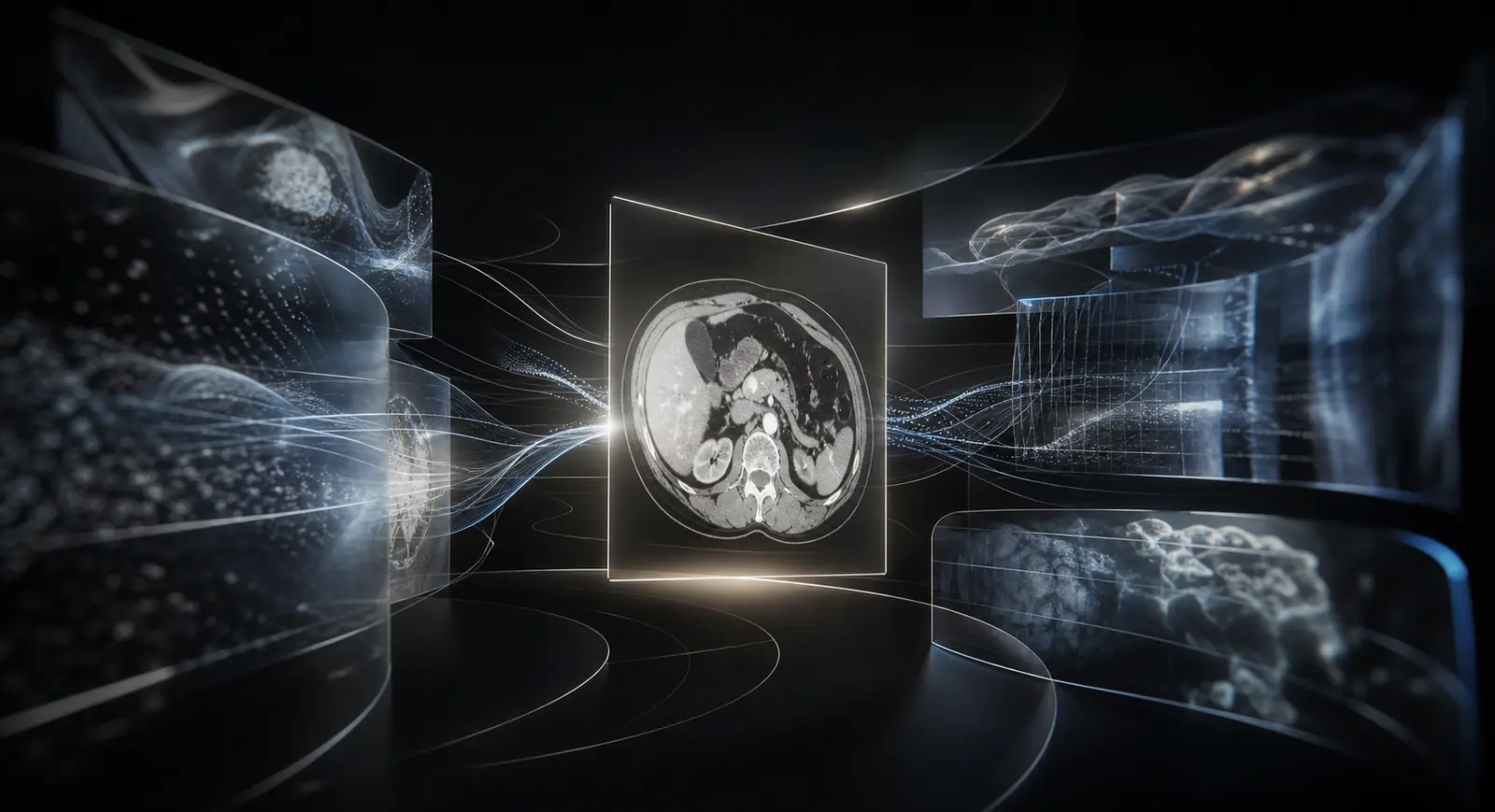
The image is one input
Interpretation happens in context.
A radiologist connects what appears on the scan with the patient's history, symptoms, previous evidence, and the clinical question being asked.
Useful together. Not interchangeable.
What each one actually brings
A radiologist brings
- Years of clinical training and pattern recognition
- Your full history, prior imaging, and referral context
- Judgement about which findings actually matter
- Professional accountability for the interpretation
- The ability to recommend next steps and further imaging
- Correlation with your symptoms and examination
An AI tool brings
- An answer in seconds instead of days or weeks
- Availability at 2am, on a weekend, anywhere
- Plain language instead of clinical shorthand
- Patience for unlimited follow-up questions
- A structured starting point for your appointment
- No cost anxiety about asking “a silly question”
Notice that these lists barely overlap. That's the point. The useful question isn't which is better, it's what each is for.
About “accuracy”
You'll see impressive accuracy figures quoted for medical AI, and much of that research is real. Published studies have shown strong performance on specific, well-defined imaging tasks, and a number of narrow AI tools have been cleared by regulators for clinical use in areas such as triage and measurement.
But those numbers belong to the exact task and dataset they were measured on: a particular finding, a particular body part, a particular scanner. They do not transfer to a general tool reading any scan of any region.
So we don't quote an accuracy percentage for LabLumen. We haven't run the kind of clinical validation study that would justify one, and we'd rather say that than borrow someone else's number.
How to use an AI reading well
Sensible uses
- Learning the vocabulary before your appointment
- Understanding a report you've already been given
- Working out which questions are worth asking
- Getting oriented while you wait for results
Please don't
- Use it to reassure yourself and skip an appointment
- Treat it as ruling anything in or out
- Change or stop medication based on it
- Panic over a finding before a professional has looked
If you are having urgent symptoms, contact emergency services or your doctor now. Do not wait for any AI analysis, ours included.
Frequently asked questions
Can AI replace a radiologist?
No. A radiologist carries years of clinical training, sees your full medical history and prior imaging, is accountable for their interpretation, and can correlate what they see with your symptoms and examination. AI reads pixels. It has no accountability, no access to your history unless you provide it, and cannot examine you. The two are not substitutes for one another.
Is AI accurate at reading scans?
Research over recent years has shown AI performing strongly on many specific, well-defined imaging tasks, and a number of narrow AI tools have been cleared by regulators for clinical use in areas such as triage and measurement. That is meaningfully different from a general tool reading any scan of any body part. Published benchmarks apply to the specific task and dataset they were measured on, and general-purpose consumer tools like LabLumen have not been through that kind of clinical validation.
What is LabLumen actually for, then?
Understanding. Most people receive a scan and a report they cannot read, and then wait days or weeks for an appointment. LabLumen gives you a plain-language walk-through of what your scan shows so you arrive at that appointment informed and with better questions. It is educational, not diagnostic.
Should I act on what LabLumen tells me?
No, not on its own. Treat it as background reading, not as a medical opinion. Every medical decision should be made with your doctor. If something in your results worries you, contact your healthcare provider rather than drawing conclusions from any AI output, ours included.
Can AI miss something a radiologist would catch?
Yes. AI can miss findings and it can report things that are not clinically meaningful. It has no way to weigh a finding against your history, your symptoms, or your prior scans the way a radiologist does. This is precisely why it should not be used to reassure yourself or to rule anything out.
Is it worth using AI at all before seeing my doctor?
Many people find it helps to walk in already understanding the vocabulary and the general picture, rather than hearing everything cold. Used that way, as preparation rather than as an answer, it can make the appointment more productive.
Understand your scan before your appointment
Not a diagnosis. A plain-language walk-through, so you walk in knowing what you're looking at and what to ask.